Every button in the Estimate — Calculators set, in plain words: what it does, what you punch in, what it gives back. Each part has a LISTEN button — hear it, or read it. Worked examples use real numbers off the actual calculators.
Cada botón del juego de Estimación — Calculadoras, en palabras claras: qué hace, qué se teclea, qué devuelve. Cada parte tiene un botón de ESCUCHAR — óigalo, o léalo. Los ejemplos usan números reales de las calculadoras de verdad.
PART 1 — THE MENU
PARTE 1 — EL MENÚ
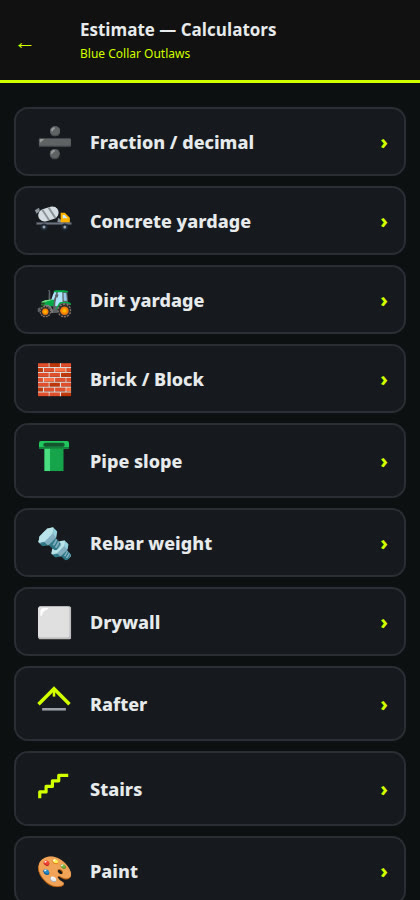
The Estimate page opens on a menu of twelve doors. Every door opens its own calculator. Every calculator figures live while you type — most also carry a CALCULATE button that just runs the same math again. The ← Back button at the bottom of a calculator (and the arrow at the top) returns to this menu. Most answers print a "Show your work" line under the number — if a number looks wrong, that line tells you exactly what the calculator used.
- Fraction / decimal — add and subtract fractions and decimals.
- Concrete yardage — how much concrete to order.
- Dirt yardage — bank / loose / compacted yards + truckloads.
- Brick / Block — counts off a wall area.
- Pipe slope — percent grade, in/ft, and drop.
- Rebar weight — pounds and tons off lineal feet.
- Drywall — sheets, screws, mud.
- Rafter — full rafter layout (Part 5).
- Stairs — code-checked stair layout (Part 6).
- Paint — gallons.
- Tape → Engineer's scale — tape inches to decimal feet ("points").
- Construction calc — the big keypad (Parts 7–10).
La página de Estimación abre en un menú de doce puertas. Cada puerta abre su propia calculadora. Cada calculadora calcula en vivo mientras escribe — la mayoría también trae un botón de CALCULAR que corre la misma cuenta otra vez. El botón de ← Volver al final de cada calculadora (y la flecha de arriba) regresa a este menú. La mayoría de las respuestas imprimen la cuenta debajo del número — si un número se ve mal, esa línea le dice exactamente qué usó la calculadora.
- Fracción / decimal — suma y resta fracciones y decimales.
- Volumen de concreto — cuánto concreto pedir.
- Volumen de tierra — yardas en banco / sueltas / compactadas + viajes.
- Ladrillo / Block — conteo desde el área de un muro.
- Pendiente de tubería — porcentaje, pulgadas por pie y desnivel.
- Peso de varilla — libras y toneladas desde pies lineales.
- Tablaroca — hojas, tornillos, pasta.
- Viga de techo — trazo completo de viga (Parte 5).
- Escaleras — trazo revisado contra el código (Parte 6).
- Pintura — galones.
- Cinta → Escala del ingeniero — pulgadas de cinta a pies decimales ("puntos").
- Calculadora de construcción — el teclado grande (Partes 7–10).
PART 2 — FRACTION CALC + TAPE → ENGINEER'S SCALE
PARTE 2 — FRACCIONES + CINTA → ESCALA DE INGENIERO
Fraction / decimal
½ FRACTION / 0.5 DECIMAL — the two mode buttons at the top. Fraction mode: each number is a whole-number box plus a fraction dropdown (sixteenths). Decimal mode: one plain box per number. Punch the First number and Second number, then + ADD or − SUBTRACT. It gives back the answer as a mixed fraction, a Decimal: line, and the math written out.
Tape → Engineer's scale
Punch Whole inches from your tape and pick the Sixteenths (0/16–16/16). It gives back decimal feet — the "points" a surveyor shoots. Two printed tables ride the page: Inches → points and Sixteenths → points.
Fracción / decimal
½ FRACCIÓN / 0.5 DECIMAL — los dos botones de modo arriba. En modo fracción, cada número lleva una casilla de entero más una lista de fracciones (dieciseisavos). En modo decimal, una sola casilla por número. Meta el Primer número y el Segundo número, después + SUMAR o − RESTAR. Devuelve la respuesta como fracción mixta, una línea de Decimal:, y la cuenta escrita.
Cinta → Escala del ingeniero
Meta las Pulgadas enteras de su cinta y escoja los Dieciseisavos (0/16–16/16). Devuelve pies decimales — los "puntos" que usa el topógrafo. Dos tablas impresas van en la página: Pulgadas → puntos y Dieciseisavos → puntos.
PART 3 — CONCRETE · DIRT · BRICK/BLOCK · REBAR
PARTE 3 — CONCRETO · TIERRA · LADRILLO/BLOCK · VARILLA
Concrete yardage
Punch Length (feet), Width (feet), Thickness (inches), and pick Waste — 5% / 10% / 15% (starts at 10%). Gives back ORDER: X CY — rounded UP to the nearest half yard — plus the 80-lb bag count and the work.
Dirt yardage
Punch Length, Width, Depth of cut (feet), Swell % (starts 28), Shrink % (starts 12), Truck capacity CY (starts 16). The big answer is truckloads; under it: Bank CY (in the ground), Loose CY (fluffed up in the truck), Compacted CY (packed back down).
Brick / Block
One input: Wall area (SF). Gives back Brick (modular) at 7 per SF, Mortar bags (brick), Block 8x8x16 with 5% waste in it, and Mortar bags (block).
Rebar weight
Punch Total lineal feet and pick the Bar size: #3 (0.376 lb/ft) · #4 (0.668) · #5 (1.043) · #6 (1.502) · #7 (2.044) · #8 (2.67) · #9 (3.40). Gives back pounds and tons.
Volumen de concreto
Meta Largo (pies), Ancho (pies), Espesor (pulgadas), y escoja el Desperdicio — 5% / 10% / 15% (empieza en 10%). Devuelve PEDIR: X yd³ — redondeado hacia ARRIBA a la media yarda más cercana — más el conteo de costales de 80 lb y la cuenta.
Volumen de tierra
Meta Largo, Ancho, Profundidad de corte (pies), Esponjamiento % (empieza en 28), Compactación % (empieza en 12), Capacidad del camión yd³ (empieza en 16). La respuesta grande es viajes de camión; abajo: yd³ en banco (en el suelo), yd³ sueltas (esponjada en el camión), yd³ compactadas (ya compactada).
Ladrillo / Block
Un solo dato: Área del muro (pies²). Devuelve Ladrillo (modular) a 7 por pie², Costales de mortero (ladrillo), Block 8x8x16 con 5% de desperdicio incluido, y Costales de mortero (block).
Peso de varilla
Meta los Pies lineales totales y escoja el Tamaño de varilla: #3 (0.376 lb/pie) · #4 (0.668) · #5 (1.043) · #6 (1.502) · #7 (2.044) · #8 (2.67) · #9 (3.40). Devuelve libras y toneladas.
PART 4 — PIPE SLOPE · DRYWALL · PAINT
PARTE 4 — PENDIENTE · TABLAROCA · PINTURA
Pipe slope — three cards
Card 1: punch Drop (inches) + Run (feet), tap CALCULATE → slope as % and in/ft. Card 2: punch Slope (%) + Run (feet), tap CALCULATE DROP → Drop needed in inches. Card 3: a printed chart lining % up against in/ft (1/8″ per ft = 1.04%, 1/4″ per ft = 2.08%).
Drywall
Punch Wall lineal feet, Ceiling height, and — only if you're rocking the ceiling — Ceiling length / width. Pick Sheet size: 4×8 or 4×12. Gives back Sheets (10% waste in), Screws (32 a sheet), Mud buckets 4.5 gal.
Paint
Punch Paintable area (SF), pick Coats 1 / 2 / 3 (starts at 2). Figured at ~350 SF per gallon per coat, rounded up. Gives back Gallons.
Pendiente de tubería — tres tarjetas
Tarjeta 1: meta Desnivel (pulgadas) + Tramo (pies), toque CALCULAR → la pendiente en % y en pulgadas por pie. Tarjeta 2: meta Pendiente (%) + Tramo (pies), toque CALCULAR DESNIVEL → Desnivel necesario en pulgadas. Tarjeta 3: una tabla impresa que alinea % con pulgadas por pie (1/8″ por pie = 1.04%, 1/4″ por pie = 2.08%).
Tablaroca
Meta Pies lineales de muro, Altura del techo, y — solo si también forra el techo — Largo / ancho del techo. Escoja el Tamaño de hoja: 4×8 o 4×12. Devuelve Hojas (10% de desperdicio incluido), Tornillos (32 por hoja), Cubetas de pasta de 4.5 gal.
Pintura
Meta el Área a pintar (pies²), escoja Manos 1 / 2 / 3 (empieza en 2). Calculado a ~350 pies² por galón por mano, redondeado hacia arriba. Devuelve Galones.
PART 5 — RAFTER
PARTE 5 — VIGA DE TECHO
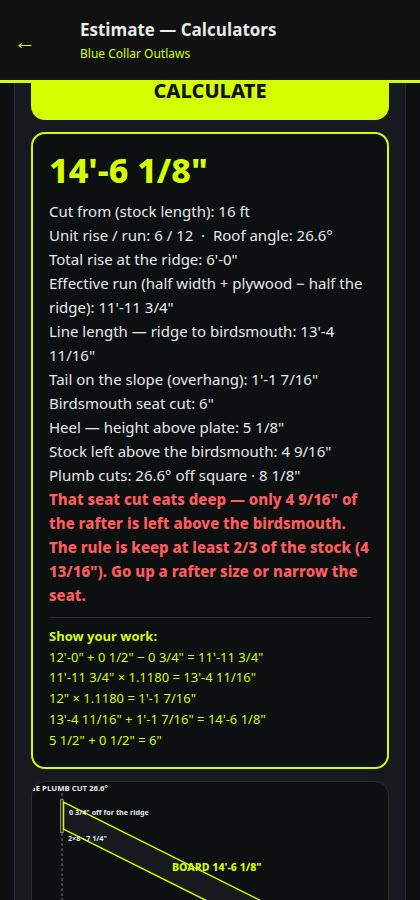
Figures a common rafter from the outside face of the wall sheathing — the page says so, and the labeled diagram under the numbers names every part (not to scale). It recalculates live as you type.
What you punch in
- Building width (ft + in) — outside of wall framing.
- PITCH / TOTAL RISE — the two mode buttons: give the roof by pitch, or by its total rise.
- Pitch — rise per 12 · or Total rise (ft + in), top of plate to top of ridge.
- Ridge board thickness (starts 1.5″) · Plywood sheathing (starts 0.5″).
- Wall plate — 2×4 (3½″) or 2×6 (5½″) · Rafter stock — 2×6 / 2×8 / 2×10 / 2×12.
- Eave overhang — horizontal, inches (starts 12).
- Rafter count (optional) — spacing — / 16″ OC / 24″ OC + Building length.
What it gives back
- Board length (the big number) + Cut from (stock length) — even feet to buy.
- Unit rise / run · Roof angle · Total rise at the ridge.
- Effective run (half width + plywood − half the ridge) · Line length — ridge to birdsmouth · Tail on the slope (overhang).
- Birdsmouth seat cut · Heel — height above plate · Stock left above the birdsmouth · Plumb cuts (degrees + inches across the board).
- Rafters, both slopes — the count, when you gave spacing + length.
- Red warning when the seat cut leaves less than 2/3 of the stock — go up a size or narrow the seat.
Calcula una viga común desde la cara exterior del forro del muro — la página lo dice, y el dibujo con nombres debajo de los números nombra cada parte (no está a escala). Recalcula en vivo mientras escribe.
Lo que usted mete
- Ancho del edificio (pies + pulg) — por fuera de la estructura del muro.
- PENDIENTE / ALTURA TOTAL — los dos botones de modo: dé el techo por pendiente, o por su altura total.
- Pendiente — subida por cada 12 · o Altura total (pies + pulg), de la parte alta de la placa a la parte alta de la cumbrera.
- Espesor de la tabla de cumbrera (empieza en 1.5″) · Plywood del forro (empieza en 0.5″).
- Placa del muro — 2×4 (3½″) o 2×6 (5½″) · Madera de la viga — 2×6 / 2×8 / 2×10 / 2×12.
- Voladizo del alero — horizontal, pulgadas (empieza en 12).
- Conteo de vigas (opcional) — separación — / 16″ al centro / 24″ al centro + Largo del edificio.
Lo que le devuelve
- Largo de la tabla (el número grande) + Cortar de (largo de madera) — los pies pares a comprar.
- Subida / avance unitarios · Ángulo del techo · Altura total en la cumbrera.
- Avance efectivo (mitad del ancho + plywood − mitad de la cumbrera) · Largo de línea — cumbrera al corte de asiento · Cola sobre la pendiente (voladizo).
- Corte de asiento · Talón — altura sobre la placa · Madera que queda arriba del corte · Cortes verticales (grados + pulgadas a través de la tabla).
- Vigas, las dos pendientes — el conteo, cuando dio separación + largo.
- Aviso en rojo cuando el corte de asiento deja menos de 2/3 de la madera — suba un tamaño o haga el asiento más angosto.
PART 6 — STAIRS
PARTE 6 — ESCALERAS
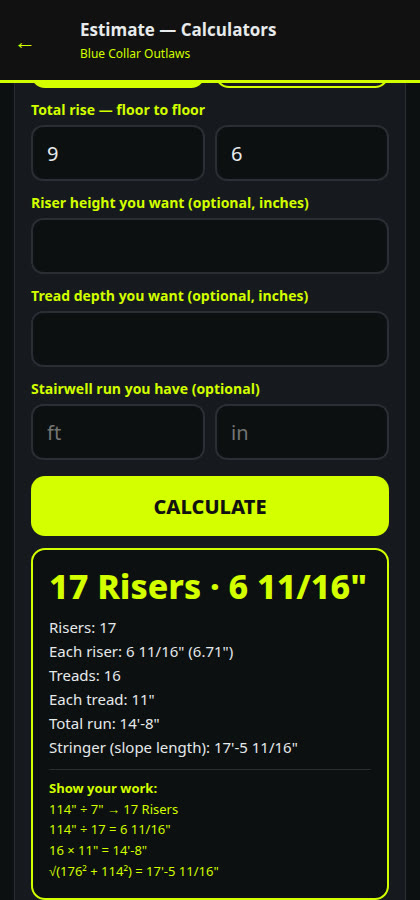
At the top, two code buttons — and the page prints the code it is holding you to:
- COMMERCIAL — IBC / NC: riser max 7″, min 4″ · tread min 11″.
- RESIDENTIAL — IRC / NC: riser max 7¾″ · tread min 10″.
What you punch in
- Total rise — floor to floor (ft + in) — the one number you must have.
- Riser height you want (optional) · Tread depth you want (optional).
- Stairwell run you have (optional, ft + in) — the room the stair has to fit in.
What it gives back
- Risers count + Each riser · Treads + Each tread · Total run · Stringer (slope length).
- A fits / does-NOT-fit verdict against the stairwell run you gave it.
- Warnings when a wanted riser/tread breaks the code you picked — it re-figures a legal count instead of handing you a bad stair.
- A profile diagram of the stair, and the standing note: risers all equal — code allows ≤ 3/8″ variation in a flight.
Same rise, residential: 15 risers at 7 5/8″ · 14 treads at 10″ · run 11′-8″.
Arriba, dos botones de código — y la página imprime el código que le está aplicando:
- COMERCIAL — IBC / NC: peralte máx 7″, mín 4″ · huella mín 11″.
- RESIDENCIAL — IRC / NC: peralte máx 7¾″ · huella mín 10″.
Lo que usted mete
- Altura total — de piso a piso (pies + pulg) — el único número obligatorio.
- Peralte que quiere (opcional) · Huella que quiere (opcional).
- Tramo de hueco que tiene (opcional, pies + pulg) — el espacio donde tiene que caber la escalera.
Lo que le devuelve
- Peraltes (conteo) + Cada peralte · Huellas + Cada huella · Avance total · Zanca (largo sobre la pendiente).
- Un veredicto de cabe / NO cabe contra el tramo de hueco que le dio.
- Avisos cuando un peralte o huella que pidió rompe el código escogido — vuelve a calcular un conteo legal en vez de entregarle una escalera mala.
- Un dibujo de perfil de la escalera, y la nota fija: peraltes todos iguales — el código permite ≤ 3/8″ de variación en un tramo.
La misma altura, residencial: 15 peraltes de 7 5/8″ · 14 huellas de 10″ · avance 11′-8″.
PART 7 — THE KEYPAD: SCREEN, TYPING, EVERYDAY MATH
PARTE 7 — EL TECLADO: PANTALLA, TECLEO, CUENTAS DE TODOS LOS DÍAS
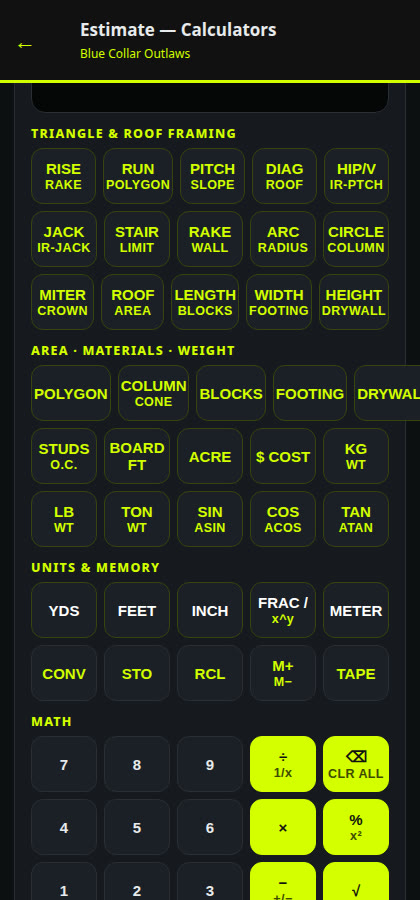
The screen
- Status line (top) — flags CONV / STO / RCL when armed, PTCH when a pitch is stored, M when the memory holds something, and the fraction resolution (RES 1/16).
- Label line — names what you're looking at (DIAG, AREA, RISER HT…).
- Main value — the big number. Lengths read feet-inch-fraction. If you mix units that don't go together, it flashes DIM? and keeps your entry.
- Equation line — the math you're in the middle of.
- TAPE panel — your last 20 results. Clearing the calculator does NOT erase the tape.
Typing feet, inches, fractions
Punch the number, then the unit key: FEET, INCH, YDS (yards), METER. Compound entries chain: 10 FEET 6 INCH = 10′ 6″. Fractions: punch whole inches, tap INCH, then numerator, FRAC, denominator, INCH — 4 INCH 1 FRAC 2 INCH = 4-1/2″. Tap the same unit twice and you're typing square measure; three times, cubic. A bare fraction with no unit counts as inches.
Everyday math keys
- 0–9 digits · . decimal point · ⌫ erases one digit (after an answer, erases the answer) · CONV ⌫ = CLR ALL.
- + − × ÷ = — chained math works (2 + 3 × 4 = 20, left to right). Length × length = area; area ÷ length = length; length ÷ length = a plain ratio.
- % — 200 + 10 % = 220 · 350 × 8 % = 28 · a lone % shows the number as a percent.
- √ square root (of an area, it gives the side: √ of 240 SQ FT = 15′ 5-7/8″) · ÷ key's partner 1/x flips a number (4 → 0.25) · CONV % = x² (15 → 225) · CONV FRAC = x^y (2 ^ 10 = 1024) · CONV + = π.
- SIN COS TAN — trig on an angle · CONV first = ASIN / ACOS / ATAN (0.5, CONV SIN → 30°).
- ON/C — clears the entry; tap twice: clears the work, keeps stored settings + tape. OFF — clears work + the memory register; tape still stays.
La pantalla
- Línea de estado (arriba) — marca CONV / STO / RCL cuando están armados, PTCH cuando hay una pendiente guardada, M cuando la memoria guarda algo, y la resolución de fracciones (RES 1/16).
- Línea de nombre — nombra lo que está mirando (DIAG, ÁREA, PERALTE…).
- Valor principal — el número grande. Los largos se leen pies-pulgadas-fracción. Si mezcla unidades que no combinan, marca ¿DIM? y guarda su tecleo.
- Línea de la cuenta — la operación que trae en curso.
- Panel CINTA — sus últimas 20 respuestas. Limpiar la calculadora NO borra la cinta.
Cómo teclear pies, pulgadas y fracciones
Teclee el número, después la tecla de unidad: PIES, PULG, YDS (yardas), METRO. Las medidas compuestas se encadenan: 10 PIES 6 PULG = 10′ 6″. Fracciones: teclee las pulgadas enteras, toque PULG, después numerador, FRAC, denominador, PULG — 4 PULG 1 FRAC 2 PULG = 4-1/2″. Toque la misma unidad dos veces y teclea medida cuadrada; tres veces, cúbica. Una fracción sola, sin unidad, cuenta como pulgadas.
Teclas de cuentas de todos los días
- 0–9 dígitos · . punto decimal · ⌫ borra un dígito (después de una respuesta, borra la respuesta) · CONV ⌫ = BORRAR TODO.
- + − × ÷ = — las cuentas encadenadas corren (2 + 3 × 4 = 20, de izquierda a derecha). Largo × largo = área; área ÷ largo = largo; largo ÷ largo = una razón sencilla.
- % — 200 + 10 % = 220 · 350 × 8 % = 28 · un % solo muestra el número como porcentaje.
- √ raíz cuadrada (de un área, da el lado: √ de 240 pies² = 15′ 5-7/8″) · la pareja de ÷, 1/x, voltea un número (4 → 0.25) · CONV % = x² (15 → 225) · CONV FRAC = x^y (2 ^ 10 = 1024) · CONV + = π.
- SIN COS TAN — trigonometría sobre un ángulo · CONV primero = ASIN / ACOS / ATAN (0.5, CONV SIN → 30°).
- ON/C — limpia lo tecleado; dos toques: limpia el trabajo, guarda los ajustes + la cinta. OFF — limpia el trabajo + el registro de memoria; la cinta se queda.
PART 8 — THE KEYPAD: CONV, MEMORY, STORED SETTINGS
PARTE 8 — EL TECLADO: CONV, MEMORIA, AJUSTES GUARDADOS
CONV is the busiest key on the pad. The small word under a key is its CONV partner — tap CONV first, then the key (that's printed right on the calculator). CONV also converts what's on screen:
CONV + a number key — the shortcut shelf
- CONV 0 = $ COST · CONV 1 = KG · CONV 2 = ACRE · CONV 3 = metric ton · CONV 4 = LB · CONV 5 = STUDS · CONV 6 = TON · CONV 7 = CM · CONV 8 = BOARD FT · CONV 9 = MM.
STO / RCL — your stored settings
STO + a key stores; RCL + the same key reads it back.
- STO 0 — weight-per-volume (tap again to step its unit: TON/CU YD → LB/CU YD → LB/CU FT → metric). STO 1 / 2 / 3 — memory registers. STO 4 — block size. STO 5 — O.C. spacing. STO 6 — footing size. STO 7 — default riser height. STO 8 — floor thickness (the STAIR key uses it). STO 9 — default tread. STO MITER — spring angle (starts 45°).
M+ / memory pile
- M+ adds the number on screen to the pile · CONV M+ = M− subtracts.
- RCL then M+ steps the pile: MEM TOTAL → MEM AVG → MEM COUNT. RCL then = toggles the TAPE panel on/off.
RES and D:M:S
- RES (small word 1/16) — steps the fraction resolution: 1/16 → 1/32 → 1/64 → 1/2 → 1/4 → 1/8 → back to 1/16. The answer re-reads at the new fineness. Example: 0.84375″ reads 0-7/8″ at 1/16; tap RES → 0-27/32″.
- CONV . = D:M:S — flips an angle to degrees-minutes-seconds: plumb cut 26.57° → 26° 33′ 54″.
CONV es la tecla más ocupada del teclado. La palabra pequeña debajo de una tecla es su pareja CONV — toque CONV primero, después la tecla (eso está impreso en la misma calculadora). CONV también convierte lo que está en pantalla:
CONV + una tecla de número — la repisa de atajos
- CONV 0 = COSTO $ · CONV 1 = KG · CONV 2 = ACRE · CONV 3 = tonelada métrica · CONV 4 = LB · CONV 5 = MONTANTES · CONV 6 = TON · CONV 7 = CM · CONV 8 = PIE TABLA · CONV 9 = MM.
STO / RCL — sus ajustes guardados
STO + una tecla guarda; RCL + la misma tecla lo lee de vuelta.
- STO 0 — peso por volumen (toque otra vez para cambiar su unidad: TON/YD³ → LB/YD³ → LB/PIE³ → métrico). STO 1 / 2 / 3 — registros de memoria. STO 4 — tamaño del block. STO 5 — separación al centro. STO 6 — tamaño de zapata. STO 7 — peralte de costumbre. STO 8 — espesor de piso (lo usa la tecla de ESCALERA). STO 9 — huella de costumbre. STO INGLETE — ángulo de resorte (empieza en 45°).
M+ / la pila de memoria
- M+ suma el número en pantalla a la pila · CONV M+ = M− resta.
- RCL y después M+ camina la pila: TOTAL → PROMEDIO → CONTEO. RCL y después = prende y apaga el panel de la CINTA.
RES y D:M:S
- RES (palabra pequeña 1/16) — cambia la resolución de fracciones: 1/16 → 1/32 → 1/64 → 1/2 → 1/4 → 1/8 → de vuelta a 1/16. La respuesta se relee a la nueva fineza. Ejemplo: 0.84375″ se lee 0-7/8″ en 1/16; toque RES → 0-27/32″.
- CONV . = D:M:S — voltea un ángulo a grados-minutos-segundos: corte vertical de 26.57° → 26° 33′ 54″.
PART 9 — THE KEYPAD: FRAMING KEYS
PARTE 9 — EL TECLADO: TECLAS DE ESTRUCTURA
The roof triangle lives on five keys. Give it any two of RISE / RUN / PITCH / DIAG and it solves the rest. Keys with a list of answers step to the next answer each tap.
- RISE (partner RAKE) — the vertical leg. RUN (partner POLYGON) — the horizontal leg. PITCH (partner SLOPE) — punch it as inches of rise per 12 (6 INCH PITCH). Tapping PITCH steps: PTCH → degrees → % GRADE → SLOPE (decimal). DIAG (partner ROOF) — the common rafter; tapping steps: DIAG → PLMB CUT → LEVL CUT (angles).
- HIP/V — hip or valley rafter length; tapping steps its PLMB / LEVL / CHEK / BAK cuts. CONV HIP/V = IR-PTCH: punch an inches-per-12 value first, then CONV HIP/V to set the irregular pitch.
- JACK — steps: JACK O.C. → INCR (the increment each jack drops) → JACK 1, JACK 2, … each shorter by the increment. CONV JACK = IR-JACK — the same walk on the irregular side.
- STAIR — figures a stair off the total rise on screen + your stored default riser (STO 7) and tread (STO 9). Steps: RISER HT → RISERS → RISER +/− → TREAD WD → TREADS → TOT RUN → OPENING → STRINGER → INCLINE (then the mm readings). CONV STAIR = LIMIT — figures off the code limits instead: smallest legal riser count, commercial or residential per the STAIR key's stored code.
- RAKE (CONV partner of RISE; small word WALL) — rake-wall studs: needs pitch + the rake run on screen (the HEIGHT value). Steps: RAKE O.C. → RW 1, RW 2, … stud lengths down the slope.
- ARC — punch a diameter (CIRCLE) and an angle, then steps: ARC ANGLE → ARC LENGTH → CHORD → SEG RISE → SEG RUN → SEG AREA, then arched-wall stud steps (AW 1 OUT / AW 1 IN…). CONV ARC = RADIUS — radius from a chord (RUN) + segment rise (RISE) on screen.
- CIRCLE — punch the diameter; steps: DIAMETER → AREA → CIRCUMFERENCE. CONV CIRCLE = COLUMN — round column / cone volume with a HEIGHT on screen.
- MITER — punch the corner angle; steps: MITER → BEVEL → SPRING (the stored spring angle it used). Punch a plain number of sides instead and the corner comes from the side count. CONV MITER = CROWN — crown figured for cutting it flat.
STAIR key, rise 9′ 6″ (default riser stored): RISER HT 7-5/8″ · RISERS 15 · STRINGER 14′ 8-1/16″. CONV STAIR (commercial limits): RISER HT 7-1/8″.
CIRCLE dia 10 FT: AREA 78.54 SQ FT · CIRCUMF 31′ 5″. ARC dia 20 FT, 90°: ARC LENGTH 15′ 8-1/2″ · CHORD 14′ 1-11/16″. MITER corner 90: MITER 35.26° · BEVEL 30.00°.
El triángulo del techo vive en cinco teclas. Dele dos de SUBIDA / AVANCE / PENDIENTE / DIAG y resuelve el resto. Las teclas con lista de respuestas avanzan a la siguiente respuesta con cada toque.
- SUBIDA (pareja RAKE) — el lado vertical. AVANCE (pareja POLÍGONO) — el lado horizontal. PENDIENTE (pareja CAÍDA) — tecleela como pulgadas de subida por cada 12 (6 PULG PENDIENTE). Tocar PENDIENTE avanza: PENDIENTE → grados → % de caída → pendiente decimal. DIAG (pareja TECHO) — la viga común; al tocar avanza: DIAG → CORTE VERTICAL → CORTE A NIVEL (ángulos).
- CADERA/V — largo de la viga de cadera o valle; al tocar avanza sus cortes VERTICAL / A NIVEL / MEJILLA / RESPALDO. CONV CADERA/V = PEND-IRREG: teclee primero un valor de pulgadas por 12, después CONV CADERA/V para fijar la pendiente irregular.
- JACK — avanza: JACK AL CENTRO → INCREMENTO (lo que baja cada jack) → JACK 1, JACK 2, … cada uno más corto por el incremento. CONV JACK = JACK-IRREG — el mismo recorrido del lado irregular.
- ESCALERA — calcula una escalera desde la altura total en pantalla + su peralte guardado (STO 7) y huella guardada (STO 9). Avanza: PERALTE → PERALTES → PERALTE +/− → HUELLA → HUELLAS → AVANCE TOTAL → ABERTURA → ZANCA → INCLINACIÓN (después las lecturas en mm). CONV ESCALERA = LÍMITE — calcula desde los límites del código: el conteo legal más chico, comercial o residencial según el código guardado de la tecla.
- RAKE (pareja CONV de SUBIDA; palabra pequeña MURO) — montantes de muro inclinado: necesita la pendiente + el avance inclinado en pantalla (el valor de ALTO). Avanza: RAKE AL CENTRO → RW 1, RW 2, … largos de montante bajando la pendiente.
- ARCO — teclee un diámetro (CÍRCULO) y un ángulo, después avanza: ÁNGULO DE ARCO → LARGO DE ARCO → CUERDA → SUBIDA DEL SEGMENTO → AVANCE DEL SEGMENTO → ÁREA DEL SEGMENTO, después los pasos de montantes de muro en arco (AW 1 FUERA / AW 1 DENTRO…). CONV ARCO = RADIO — el radio desde una cuerda (AVANCE) + subida del segmento (SUBIDA) en pantalla.
- CÍRCULO — teclee el diámetro; avanza: DIÁMETRO → ÁREA → CIRCUNFERENCIA. CONV CÍRCULO = COLUMNA — volumen de columna redonda / cono con un ALTO en pantalla.
- INGLETE — teclee el ángulo de la esquina; avanza: INGLETE → BISEL → RESORTE (el ángulo de resorte guardado que usó). Teclee en cambio un número sencillo de lados y la esquina sale del conteo de lados. CONV INGLETE = CORONA — corona calculada para cortarla acostada.
Tecla ESCALERA, altura 9′ 6″ (peralte guardado): PERALTE 7-5/8″ · PERALTES 15 · ZANCA 14′ 8-1/16″. CONV ESCALERA (límites comerciales): PERALTE 7-1/8″.
CÍRCULO diámetro 10 PIES: ÁREA 78.54 pies² · CIRCUNF 31′ 5″. ARCO diámetro 20 PIES, 90°: LARGO DE ARCO 15′ 8-1/2″ · CUERDA 14′ 1-11/16″. INGLETE esquina 90: INGLETE 35.26° · BISEL 30.00°.
PART 10 — THE KEYPAD: LENGTH / WIDTH / HEIGHT + MATERIALS
PARTE 10 — EL TECLADO: LARGO / ANCHO / ALTO + MATERIALES
- LENGTH — stores the length. WIDTH — stores the width; keep tapping: WIDTH → AREA → SQUARE-UP (the diagonal, for squaring a layout) → PERIMETER → LENGTH → around. HEIGHT — stores the height; keep tapping: HEIGHT → VOLUME → WALL AREA → ROOM AREA (floor + walls).
- ROOF (CONV DIAG) — with LENGTH + WIDTH + PITCH on board, steps: ROOF AREA → SQUARES → BUNDLES → 4×8 SHEETS → 4×12 SHEETS. Squares, bundles and sheets come out as decimals — round up when you order.
- BLOCKS (CONV LENGTH) — block count for a LENGTH × HEIGHT wall at the stored block size (STO 4). FOOTING (CONV WIDTH) — footing concrete (CU YD) for a LENGTH run at the stored footing cross-section (STO 6 — the pad starts at a 12″ × 22″ footing). DRYWALL (CONV HEIGHT) — sheets for a LENGTH × WIDTH floor; steps 4×8 → 4×9 → 4×12. (The keypad counts full sheets off the area — the Drywall page in Part 4 is the one that adds waste, screws and mud.)
- STUDS (small word O.C.) — studs for a LENGTH wall at the stored spacing (STO 5, starts 16″): count = spaces + 1. BOARD FT — board feet from a VOLUME on screen (or a plain number read as cubic feet). ACRE — acres from an AREA on screen.
- $ COST — punch a rate, tap $ COST: multiplies the quantity on screen (a count, an area, a volume) by the rate.
- KG / LB / TON (small word WT) — weight keys. First store the material's weight once with STO 0 (like 1.5 = a ton and a half per cubic yard of concrete). Then any VOLUME on screen reads its weight on LB, TON or KG — and a weight on screen converts between the three.
- POLYGON (CONV RUN) — punch the circle it fits in (CIRCLE diameter) and the number of sides, then CONV RUN → FULL ANGLE of the figure.
- AW (small words IN/OUT) — flips how arched-wall studs are measured: AW INSIDE or AW OUTSIDE the arch; the screen says which way it sits.
- The two doors at the bottom of the keypad — Rafter page › and Stairs page › — jump straight to Parts 5 and 6.
- LARGO — guarda el largo. ANCHO — guarda el ancho; siga tocando: ANCHO → ÁREA → DIAGONAL DE ESCUADRA (para escuadrar un trazo) → PERÍMETRO → LARGO → y dar la vuelta. ALTO — guarda la altura; siga tocando: ALTO → VOLUMEN → ÁREA DE MUROS → ÁREA DEL CUARTO (piso + muros).
- TECHO (CONV DIAG) — con LARGO + ANCHO + PENDIENTE a bordo, avanza: ÁREA DE TECHO → ESCUADRAS → PAQUETES → HOJAS 4×8 → HOJAS 4×12. Escuadras, paquetes y hojas salen en decimales — redondee hacia arriba al pedir.
- BLOCKS (CONV LARGO) — conteo de block para un muro de LARGO × ALTO con el tamaño de block guardado (STO 4). ZAPATA (CONV ANCHO) — concreto de zapata (yd³) para un tramo de LARGO con la sección de zapata guardada (STO 6 — el teclado empieza con una zapata de 12″ × 22″). TABLAROCA (CONV ALTO) — hojas para un piso de LARGO × ANCHO; avanza 4×8 → 4×9 → 4×12. (El teclado cuenta hojas completas desde el área — la página de Tablaroca de la Parte 4 es la que suma desperdicio, tornillos y pasta.)
- MONTANTES (palabra pequeña AL CENTRO) — montantes para un muro de LARGO a la separación guardada (STO 5, empieza en 16″): el conteo es espacios + 1. PIE TABLA — pies tabla desde un VOLUMEN en pantalla (o un número sencillo leído como pies cúbicos). ACRE — acres desde un ÁREA en pantalla.
- COSTO $ — teclee una tarifa, toque COSTO $: multiplica la cantidad en pantalla (un conteo, un área, un volumen) por la tarifa.
- KG / LB / TON (palabra pequeña PESO) — teclas de peso. Primero guarde el peso del material una vez con STO 0 (como 1.5 = tonelada y media por yarda cúbica de concreto). Después cualquier VOLUMEN en pantalla lee su peso en LB, TON o KG — y un peso en pantalla se convierte entre los tres.
- POLÍGONO (CONV AVANCE) — teclee el círculo en el que cabe (diámetro por CÍRCULO) y el número de lados, después CONV AVANCE → el ÁNGULO COMPLETO de la figura.
- AW (palabras pequeñas DENTRO/FUERA) — voltea cómo se miden los montantes de muro en arco: AW POR DENTRO o AW POR FUERA del arco; la pantalla dice de qué lado está.
- Las dos puertas al final del teclado — Página de vigas › y Página de escaleras › — saltan directo a las Partes 5 y 6.